
Hearts of Venus Strategy
Session Bet Sizer
What a real Hearts of Venus strategy can and can't do

Strategy in Hearts of Venus is about the decisions you actually control: how much you stake, how long you play, and whether you touch the paid feature modes. It is not about predicting spins. Every result on this Pragmatic Play slot comes from a random number generator, so no reading of past spins tells you what the next one holds.
That leaves three things worth getting right, and they all pay off in discipline rather than in secret patterns.
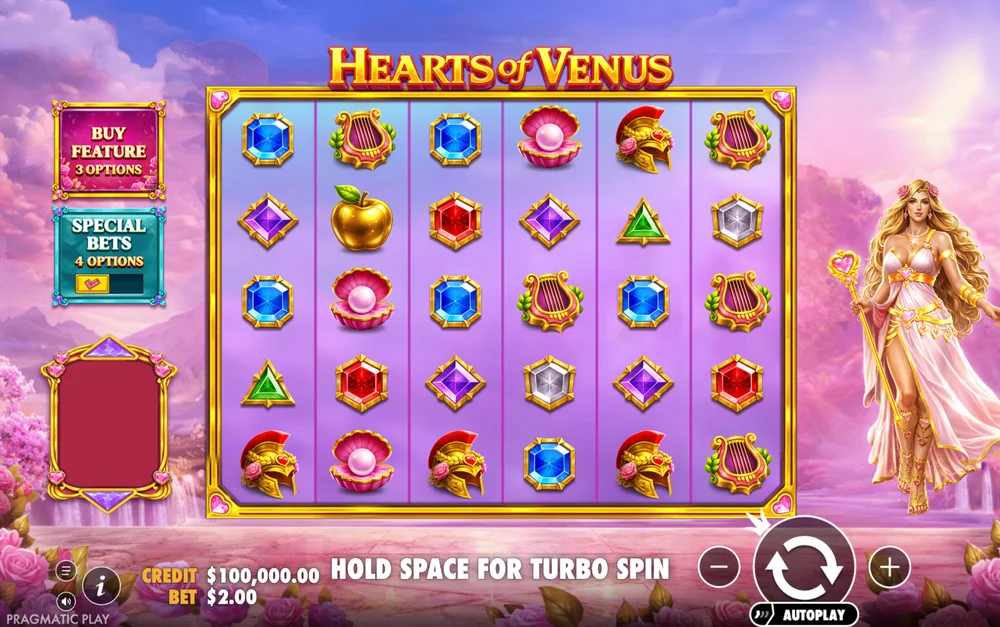
- Know the rules. The game runs on a 6×5 grid with a Pay Anywhere engine - matching symbols count wherever they land, and you need at least eight of a kind to score. Understanding that changes how you read a screen full of near-misses.
- Size your stake to your budget. With a bet range from 0.20 to 240 per spin, the same game can be a slow grind or a fast burn. Medium volatility means wins arrive at a moderate, uneven pace - enough to keep a session alive, not enough to make outcomes smooth or predictable.
- Treat features as choices, not habits. Bonus buys, the Ante Bet and the Super Spin modes each change your cost per spin sharply. They are strategic decisions with a price tag, not a shortcut to the top prize.
The honest verdict: the players who do best here are the ones who decide their limits before spinning and stick to them. There is no system that turns medium volatility into a reliable income, and the game's headline 25,000x ceiling is a rare mathematical maximum, not a target you can steer toward.
So the useful tips are the boring ones - set a session budget, pick a stake you can repeat many times over, and understand the cascade and free-spins mechanics well enough that you're never surprised by what the reels do. Everything below turns that premise into concrete rules you can apply from your first spin. If you want to rehearse the mechanics without spending, do it in the free demo first.
The core limitation
No strategy can overcome random outcomes or guarantee a win. The only edge you control is decision discipline - stake size, session limits and whether you buy features.
How to play: from your stake to a winning cascade

One detail that changes how the game feels: Multiplier Spots. A multiplier between x2 and x1,024 can appear randomly on any cell, and if a winning symbol lands on it, that value applies and then doubles. In the base game those spots stay active across the whole cascade chain and only reset when a drop produces no win. There are no wild symbols here, so every win is built from genuine matching combinations. That's the entire loop: stake, spin, match eight, ride the cascade.
Triggering free spins and how the starting multiplier scales

Free Spins are the round most players are chasing, and the Scatter count decides how strong that round starts.
- 3 Scatters award 6 free spins with a x2 starting multiplier.
- More Scatters push the opening multiplier higher, up to x16.
Once inside, the multiplier doesn't reset spin to spin - it persists to the end of the round and can climb. That climb runs on the Collect symbol, which appears during Free Spins in place of the Scatter. Every 3 Collect symbols you gather advance the Multiplier Boost one tier: x2 → x4 → x8 → x16 → x32 → x64 → x128 → x256 → x512 → x1,024. Each tier-up also adds 2 more free spins, and hitting the x1,024 cap awards 10 extra spins, though the multiplier stops rising there.
The grid also shifts in this round - it swaps in more valuable symbols than the base game, so the same cascades tend to be worth more. In practical terms, the value of a Free Spins round depends far more on how many Collect symbols you stack than on the number of Scatters that opened it. A round that starts modestly can still grow if the boosts land; one that starts high can stall if they don't.
Setting a stake and a session budget you can sustain

The single most useful tactic is to fix your budget before you spin, then work backwards to a stake that fits it. With a bet range from 0.20 to 240, the same balance lasts very different lengths depending on where you sit in that range.
A practical way to size it: decide how much you're willing to lose in a session, then pick a stake small enough to survive at least a few dozen spins of variance. Medium volatility means wins land at an uneven pace - cold stretches are normal and expected - so a stake that only allows ten or fifteen spins gives the game no room to show you anything before your budget is gone.
- Match stake to bankroll, not to hope. A €50 session and a €5 stake is ten spins; the same €50 at €0.50 is a hundred. The lower stake buys you time inside the game's natural swings.
- Set a loss limit and a stop. Decide the point at which you close the session, and treat it as fixed rather than a suggestion.
- Cost the features separately. The Ante Bet raises your cost to 3x the base stake, and the bonus-buy and Super Spin modes cost far more per action than a normal spin. Fold those into your budget before you use them, not after.
There's no stake pattern that improves your long-run odds - the point of sizing is to make your money last long enough to enjoy the game, not to bend the maths.
Don't chase losses
Raising your stake after a losing run doesn't improve your odds on the next spin - it only shortens how long your budget survives. The same goes for pushing bets to reach the 25,000x ceiling: that outcome stays rare no matter how much you wager. If you hit your loss limit, stop; don't scale up to recover it.
Where paid feature modes fit, and where they don't

Paid features change your exposure by a wide margin. The three bonus buys run at 100x, 250x and 400x total bet, and the Super Spin modes climb from 20x up to 1,000x, and those Super Spins block Free Spins entirely. A single buy can cost more than dozens of base spins, so it belongs in its own budget line, not in your regular rhythm. Weigh each option's price and starting conditions before committing; the full cost breakdown sits in the dedicated bonus buy guide.
Do tricks, algorithms or simulators actually work?

No. Outcomes here are produced by a random number generator, and the RTP is described as constant regardless of the game state. That means there is no spin timing, bet pattern, or "hot and cold" reading that shifts the odds in your favour. Every trick, hack or algorithm claim you'll find promising reliable wins runs into the same wall: the next spin is independent of the last one.
Simulators and demo play are worth using, but for what they genuinely offer. They let you learn the Pay Anywhere rule, feel out how cascades and the Multiplier Boost behave, and test stake sizes without spending money. What they can't do is forecast a real-money session, because the demo runs on the same randomness and carries no memory that a paid game would inherit. Use practice to understand the mechanics, then bring that understanding to the decisions you actually control. If you want to confirm how the game is verified, the fairness overview covers it.
Your next step from here

Pick the move that matches where you are: rehearse the mechanics in the free demo, check the numbers in the math and RTP breakdown if the maths matters to you, weigh the bonus buy options if you're considering paid features, or compare offers on the ranked casinos list when you're ready for real-money play.